Who it is for
A developer or operator coordinating coding agents across repositories, worktrees, sessions, reviews, and CI.
The problem
Assigning work to several agents creates coordination work: defining permitted files, following sessions, identifying blockers, and checking whether review and test evidence applies to the work being released.
How it is used
The intended workflow starts with a repository and a task with explicit file scope. The operator follows progress and blockers, reviews the evidence, and makes the release decision.
Controlled agent creation and delegation are planned parts of that workflow. They are explicitly disabled in the current prototype.
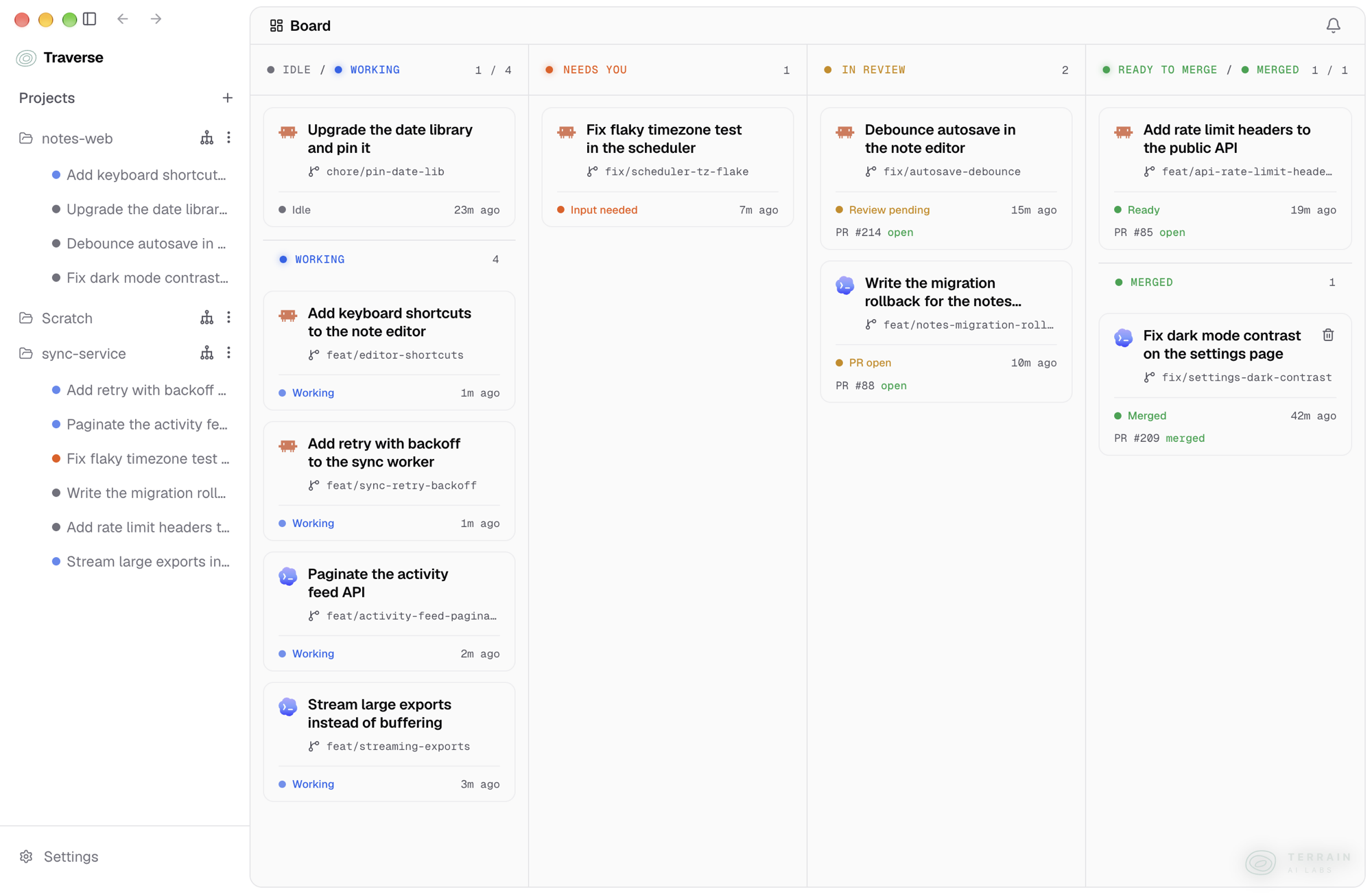
Demo data, not a recorded run. Agent creation stays disabled in the current prototype.
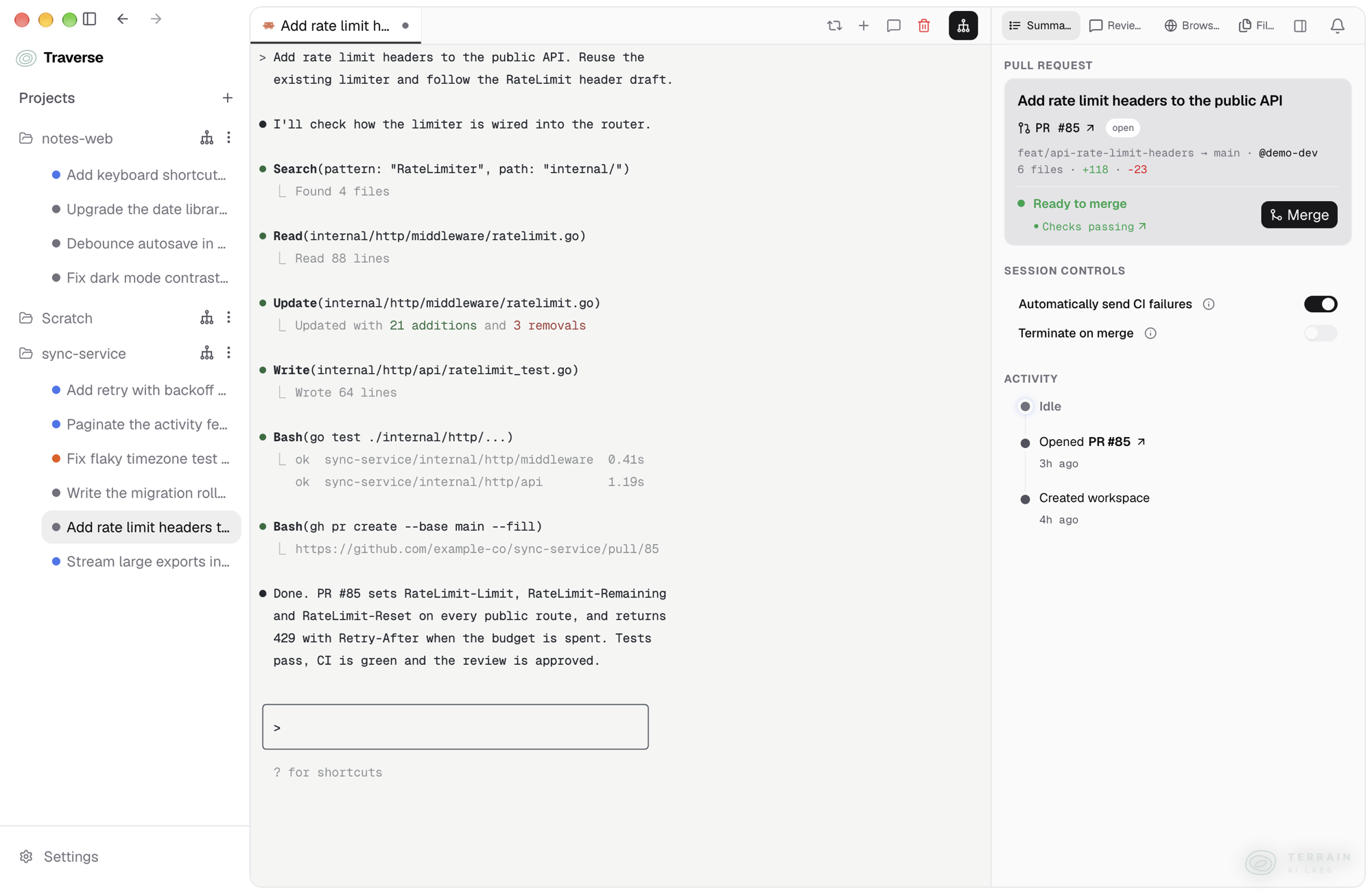
Demo data, not a recorded run. Agent creation stays disabled in the current prototype.
Constraints and decisions
The prototype has to distinguish observing work from authorizing a change. A session can be visible in the workspace without the operator having approved a new agent, worktree, or delegated task.
The current decision is to keep mutable agent creation disabled while the authorization path is unfinished. The design builds on a pinned upstream runtime and adds governance around it. The record does not establish a formal comparison of alternative runtimes.
How it works
An early local desktop prototype integrates repository registration and runtime observation. It can observe sessions, terminals, files, pull requests, and CI, with policy boundaries around the work.
The prototype uses a pinned Apache-licensed upstream runtime with Terrain governance around it. It is not a wholly original runtime.
Read the workflow as text
- Select repository. Task + permitted files. Current prototype.
- Authorize execution. Agents and worktrees. Planned; disabled today.
- Review the work. Progress, review + CI. Human release decision.
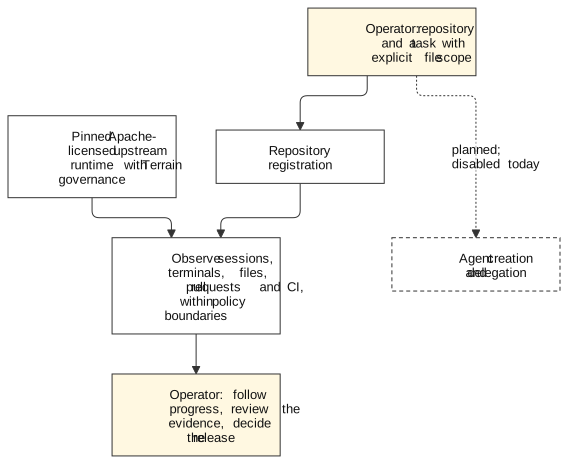
The dashed box is planned and disabled in the current prototype. Shaded boxes are the operator’s steps.
Open diagram at full size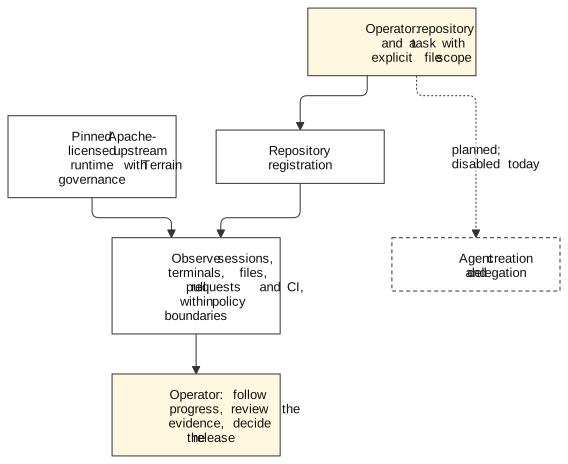
Read the workflow as text
- Operator: repository and a task with explicit file scope.
- The prototype starts with repository registration.
- On a pinned Apache-licensed upstream runtime with Terrain governance, it can observe sessions, terminals, files, pull requests and CI, within policy boundaries.
- Agent creation and delegation: planned; disabled today.
- Operator: follow progress, review the evidence, decide the release.
Current state and planned work
Built: early local desktop/runtime integration, repository registration, observation of development activity, and policy boundaries.
Still under development: controlled mutable agent execution and the authorization path. No public availability, adoption, or performance result is claimed.
I plan to build Traverse in November 2026. That is a development plan, not a confirmed launch date.
Learnings
What I learned: the earlier Harness work showed that file scope and approval freshness need explicit checks. Historical passing tests also need to be tied to the files actually in use.
What changed: Traverse carries those lessons into its policy boundaries. Mutable agent creation remains disabled while authorization is unfinished.
What to test next: verify authorization end to end before enabling execution, then check whether review and CI evidence remains bound to the exact work a human is releasing. These are proposed validation steps, not Traverse outcomes.