What the receiver probes exercised
| Condition | Boundary being checked | Recorded probe purpose |
|---|---|---|
| Correct live receiver | Process, exact role, live channel, ownership | Accept the valid binding |
| Dead receiver or missing binding | Existence and ownership | Block the handoff |
| Wrong role or spare process | Identity rather than a plausible name | Reject the wrong receiver |
| Role-prefix collision | Exact role boundary, not a loose prefix | Reject the collision |
| Structured ownership fields | Well-formed and malformed records | Exercise both acceptance and rejection |
| Read-only verification | Observed state before and after | Check that observation leaves state unchanged |
A summary of the conditions covered by historical probes, not newly executed checks or a per-row count.
A handoff can carry the right instructions to the wrong process. I worked with agent teams on a receiver check that verified identity before it let the handoff proceed.
Why receiver identity mattered
A handoff names a role, but the work lands safely only when the right live process holds that role. A matching name alone does not prove that binding, so receiver identity was worth checking directly.
The check we built
The gate checked the intended process, its role identity, a live communications socket, and structured ownership fields. A failed check blocked the handoff. The role comparison needed boundaries: a match for role-a must not also match role-ab. This was verification around an existing handoff flow. The gate itself was neither a dispatcher nor a session creator.
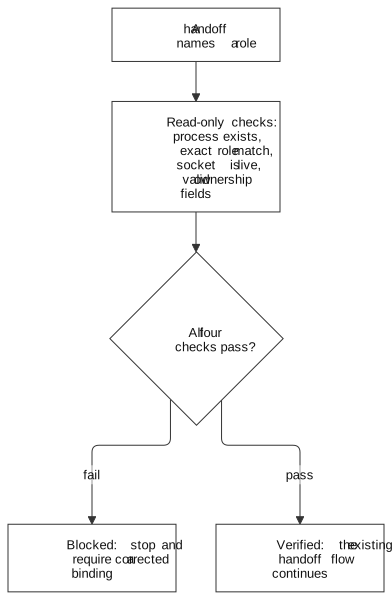
In the tested version, a failed check blocked the handoff, and the gate did not create a session or send a message.
Open diagram at full size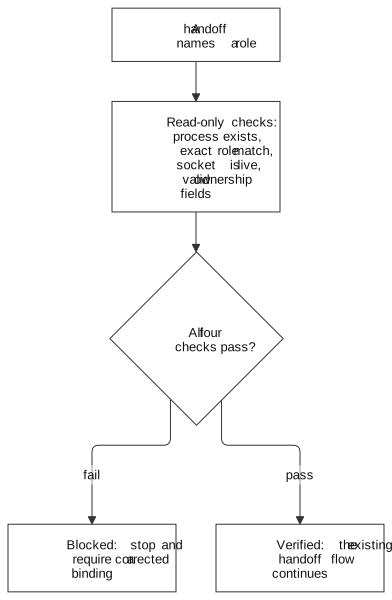
Read the workflow as text
- A handoff names a role.
- Read-only checks: process exists, exact role match, socket is live, valid ownership fields.
- In the tested version, the decision asked: all four checks pass? On fail, the result was blocked: stop and require a corrected binding.
- On pass, the result was verified: the existing handoff flow continues.
Workflow
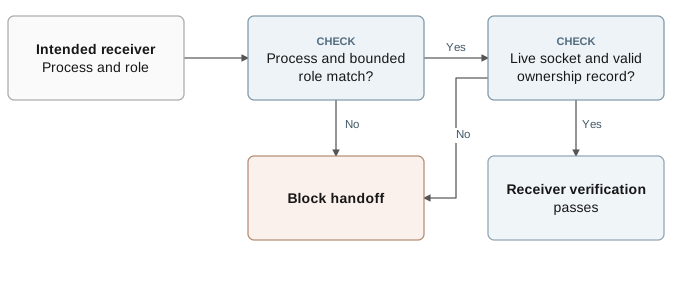
In the tested version, a failed check blocked this verification path, and the gate did not create a session or send a message.
Open diagram at full size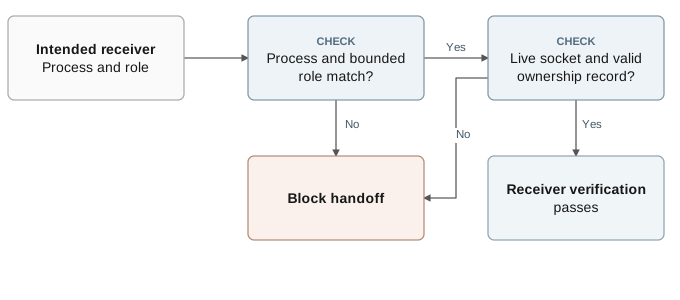
Read the workflow as text
- Start with the intended receiver: its process and role.
- Check that the process exists and its role matches exactly. If not, block the handoff.
- Check for a live socket and valid ownership fields. If not, block the handoff.
- If both checks pass, receiver verification passes.
Identity was a relationship between checks
Each check answered a different failure mode. Process identity asked whether the intended receiver existed. The bounded role match prevented a similar-looking name from being accepted. The socket checked whether the expected communication channel was live. The structured ownership record supplied another binding that had to agree. Accepting any one signal on its own would leave the other recorded failure cases unresolved.
Why a name was insufficient
A role-shaped string can be present in the wrong place or refer to stale ownership. A process can exist without the expected live communication channel. We therefore checked the relationship among process, role, socket, and ownership rather than accepting a loose name match. Correctly structured ownership data was part of the test surface, including both well-formed and malformed records.
The rejected shortcut
Handing the work to some other process when the intended receiver is uncertain trades a visible failure for a hidden one. The safer behavior was to stop on failed verification and require a corrected binding.
What the recorded probes covered
The recorded probes exercised a correct live receiver, a dead receiver, a wrong role, a spare process, a prefix collision, and a missing binding, along with well-formed and malformed ownership records. Together, they tested that plausible-looking but incorrect receivers could be rejected while a valid receiver could pass.
Checking the checker
The probes also recorded that verification was read-only: the state they observed was unchanged after each check. That matters for a verification tool. If checking identity changes the state being checked, the result becomes harder to interpret and the gate can create its own failure modes. The recorded read-only observations support that property within the exercised cases.
What I would carry forward
The result was a concrete receiver-verification mechanism with a bounded set of recorded probes. There is no incident-rate evidence here, so I would not claim a measured reduction in handoff failures. The broader lesson is practical: verify the binding between a role and its live owner, then keep that binding meaningful through the action that depends on it.